
A fire transforms a living room. It provides a natural focal point, a source of warmth on cold evenings and a sense of cosiness that is hard to create in any other way. Whether you are replacing an old fire, opening up a fireplace or adding a fire to a room that has never had one, the first big decision is usually between gas and electric.
Both have improved dramatically in recent years. Modern gas fires are more efficient and realistic than ever, while today’s electric fires look far more convincing than the glowing bars of the past. Here is how they compare.
Installation and Where They Can Go
Gas fires need a gas supply and, in most cases, a way to vent combustion gases safely. Traditional gas fires use an existing chimney or flue. Balanced-flue and power-flue models vent through an outside wall, so they can be fitted in homes without a chimney, although they need to be on or near an external wall. Flueless gas fires are also available but have specific ventilation requirements.
In the UK, any gas fire must be installed by a Gas Safe registered engineer, and installation is usually more involved and more expensive than for an electric fire.
Electric fires are far simpler. Many plug into a standard socket, and inset or wall-mounted models may need only basic electrical work. Because they need no flue or gas supply, they can be installed almost anywhere, including flats, bedrooms and rooms on internal walls.
Running Costs and Heat
Gas is generally cheaper per unit of energy than electricity in the UK, so a gas fire used as a main source of heat in a room usually costs less to run than an electric fire producing the same warmth. Modern glass-fronted gas fires can be highly efficient, although open-fronted and decorative gas fires lose much of their heat up the chimney.
Electric fires convert almost all the electricity they use into heat in the room, so they are efficient at the point of use, but the higher price of electricity typically makes them more expensive per hour of heating. Many electric fires allow the flame effect to run without the heater, using very little power, which is ideal for creating atmosphere without adding heat.
If you want a fire mainly for occasional warmth and ambience, the difference in running costs may be small. If it will be a main heat source on winter evenings, gas usually works out cheaper.
Looks and Realism
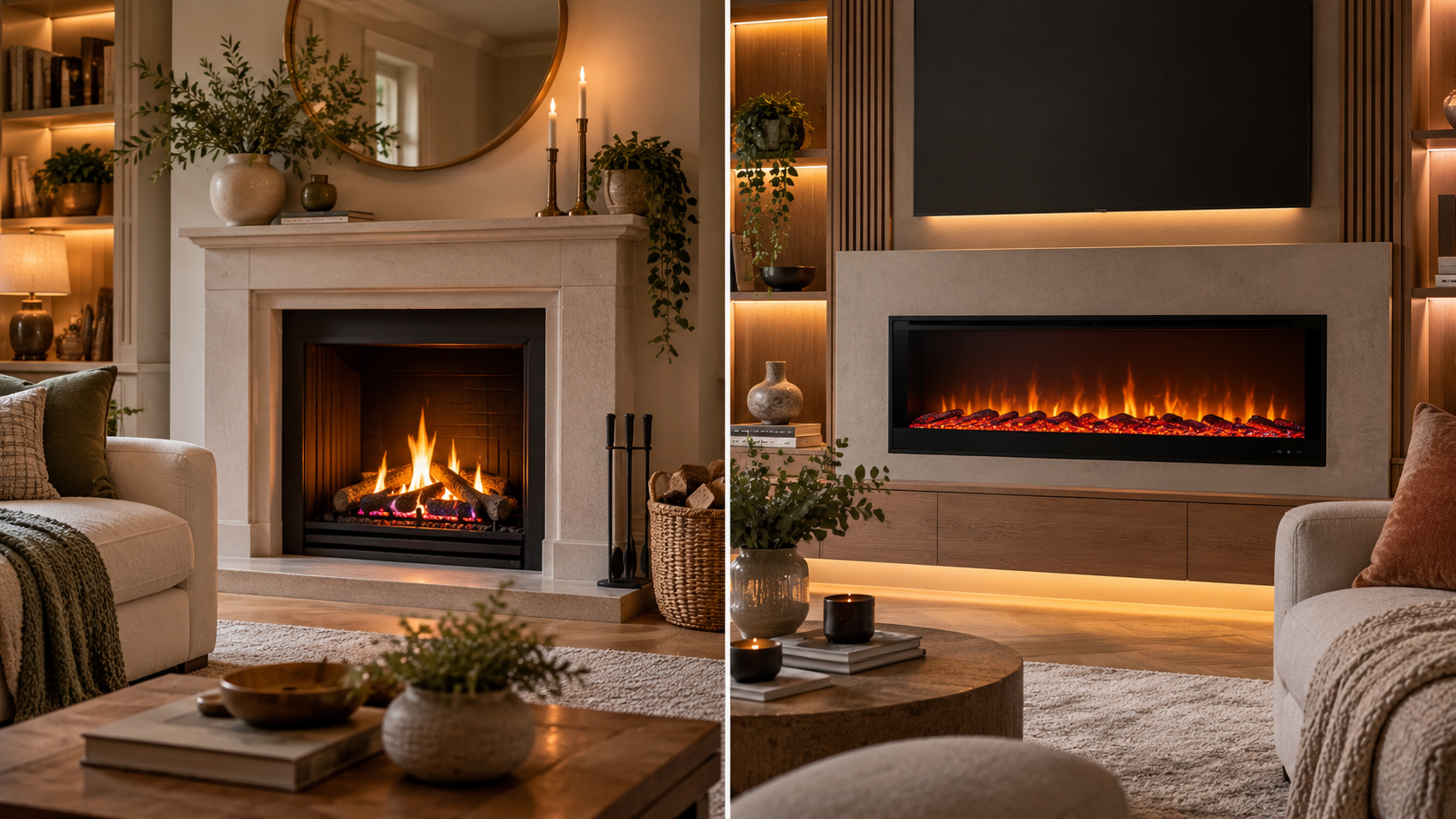
Gas fires produce a real flame, and many people feel nothing can match the way it flickers and glows. Designs range from traditional coal and log effects in classic surrounds to sleek, frameless contemporary fires and pebble beds.
Electric fires have come a long way. LED and water-vapour flame effects can be remarkably realistic, and many models offer adjustable flame colours and brightness. Media walls with built-in electric fires have become a popular feature in modern homes, often combined with a mounted television.
Nordic homes have long put the fire at the heart of the living space, usually a wood-burning stove surrounded by simple, natural materials, and our feature on Scandinavian furniture design explores how that tradition shapes a calm, comfortable room. If you are restoring a period fireplace, reclamation yards and auctions are excellent sources of original surrounds and mantelpieces, and our guide to buying vintage and second-hand furniture covers how to buy well from them.
Safety and Maintenance
Gas fires should be serviced annually by a Gas Safe registered engineer, and a carbon monoxide alarm should be fitted in the same room. Chimneys used for gas fires may also need periodic sweeping and checking.
Electric fires need very little maintenance beyond occasional cleaning and, for some water-vapour models, refilling or replacing parts. There are no combustion gases, so carbon monoxide is not a concern, and many models have cool-touch glass, which is helpful in homes with young children.
Making the Right Choice
Choose a gas fire if you have a gas supply and a suitable chimney or external wall, want a real flame and plan to use the fire regularly for heat. Choose an electric fire if you want flexibility of location, simple installation, minimal maintenance or a fire mainly for ambience.
It is also worth considering the long term. As the UK moves away from gas heating in new homes, electric fires offer a degree of future-proofing, while a good gas fire remains an efficient choice in homes already connected to the gas network. Whichever you choose, get professional advice on installation and make sure the fire suits the size of the room.